 EV Charger Installation
Commercial EV Charging Installation
Commercial sites need load planning, conduit runs, trenching and often network-enabled chargers with payment or access control. Projects range from a few ports at an office to full fleet depots with dozens of chargers.
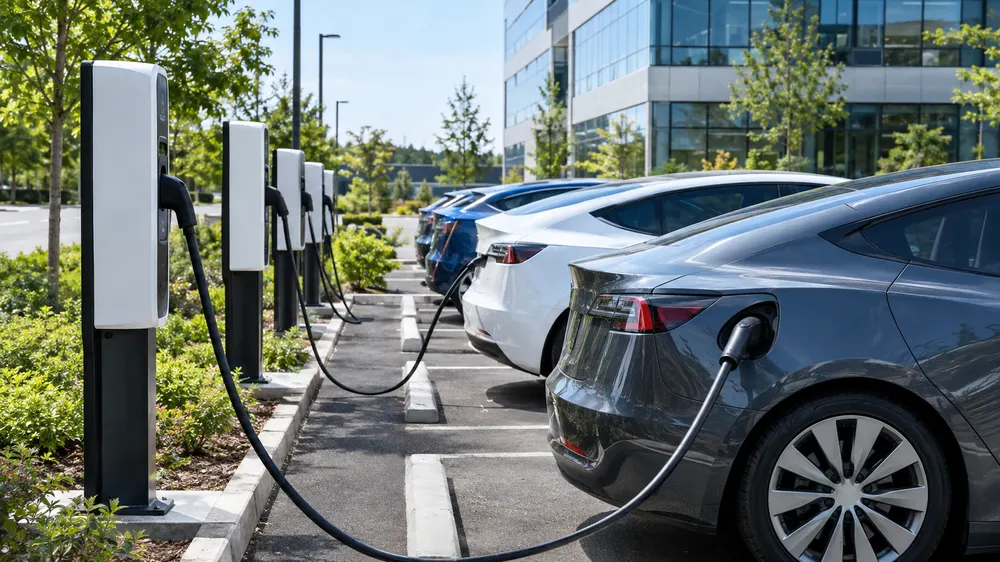
Commercial charging, scaled up
Commercial EV charging is the same physics as home charging with more of everything: more chargers, more power, more coordination. Projects range from a pair of Level 2 chargers in an office lot to depot charging for a fleet of vans, and the contractors who do this work handle site design, utility coordination, permitting and the incentive paperwork alongside the electrical work itself.
The first decisions are about use, not hardware. Who charges here, employees, customers, tenants or fleet vehicles? How long do they stay? A workplace where cars sit eight hours can serve many vehicles with modest Level 2 units and load sharing. Retail sites want faster turnover. Fleets need overnight certainty and often schedule charging so every vehicle leaves full by shift time. The answers size the equipment, the electrical service and the budget.
Power and utility coordination
Power is usually the long-lead item. A bank of chargers can demand more capacity than the building's existing service provides, and new commercial service or a transformer upgrade runs on the utility's calendar, sometimes months out. Early conversations with the utility matter, and many utilities now run make-ready programs that pay for some or all of the infrastructure between the grid and the charger, including trenching, conduit and panels. Those programs typically require approval before construction starts, so the incentive application belongs at the front of the project plan, not the end.
Load management is standard practice commercially: networked chargers share capacity intelligently, which often halves the service upgrade a site would otherwise need. Demand charges, the commercial rate component based on peak draw, are the other planning item; smart scheduling keeps midday peaks from becoming the most expensive electricity on the bill.
Networking and payment
Commercial chargers run on software. Networked units handle driver authentication, payment collection, energy reporting and remote diagnostics. Choices here are about who pays: free employee charging with RFID access, customer charging at per-kWh or per-hour pricing, or fleet charging that simply tracks energy per vehicle. The network subscription is an ongoing cost to budget alongside electricity.
Timeline and process
A small commercial project, two to six Level 2 chargers on existing capacity, can move from design to operation in a few weeks. Larger projects with service upgrades, make-ready applications or DC fast equipment run months. A realistic sequence: site assessment, utility pre-application, incentive applications, design and permitting, construction, commissioning. The contractors we refer handle the whole arc.
Why businesses install charging
The business cases differ but repeat: workplaces use charging to recruit and retain employees who drive electric; retail and hospitality sites find that charging customers stay longer and spend more; property managers treat chargers as an amenity that leases units; fleets electrify to cut fuel and maintenance costs, and depot charging is what makes the vehicles usable. In many markets, visible charging also carries a simple signal that the business is current. Whatever the driver, the underlying advice is the same: design for the use case, apply for incentives early, and size the infrastructure for the next expansion while the trench is open.
Working with an independent electrician
evchargerinstallation.org is a referral service, not a contractor. When you call, we connect you with an independent electrician who serves your area and handles commercial EV charging projects regularly. The contractor inspects your setup, provides a written estimate, pulls the permit where required, completes the work and stands behind it. You pay the contractor directly at a price they set, and the written estimate is the number to rely on. Our role is the first step: making sure one phone call reaches someone local and experienced.
What to have ready when you call
A few details make the first conversation productive. Your ZIP code routes the call. Your vehicle's make and model determines the charging rate the circuit should target. Where you park, garage, driveway or shared lot, shapes the install type. If you know your panel's main breaker size, usually stamped 100, 150 or 200, mention it; a photo of the open panel sent later helps the electrician quote accurately. And if you have a deadline, like a vehicle delivery date, say so up front.
Common questions
Are the contractors independent?
Yes. Every electrician we refer runs an independent business. They set their own pricing, carry their own insurance and are solely responsible for their work.
Do cost figures here apply to my home?
They are rough planning ranges drawn from typical jobs. Your home's panel, wire run and local labor market decide the real number, which is why every estimate here is followed by the same advice: get it in writing from the electrician who sees your panel.
Is the federal tax credit still available?
No. The Section 30C credit for home charging equipment ended for property placed in service after June 30, 2026. State, local and utility programs may still apply and are listed on each state page.
How fast can someone come out?
Scheduling varies by market and season. In most areas an estimate visit happens within days, and the work itself within one to three weeks including permits. Vehicle delivery dates are worth mentioning when you call.
The job, step by step
Knowing the sequence removes most of the anxiety from any electrical project. It begins with the estimate visit or photo review, where the electrician examines the panel, confirms capacity with a load calculation, measures the wire route and talks through equipment options. The written estimate follows, listing the circuit size, materials, equipment, permit fees and labor so the scope is unmistakable. Once you approve, the contractor pulls the permit and schedules the work.
Install day starts with the power to the work area shut off and locked out. The new breaker lands in the panel, wire is pulled along the planned route through conduit or finished framing, and the equipment is mounted, connected and configured. Smart units join your Wi-Fi and get their scheduling set. The electrician then tests the circuit under load, verifies voltage and polarity, labels the panel and walks you through operation and basic care. The inspection closes the loop on the city or county's schedule, usually within days, and the documented, permitted circuit becomes part of the house.
After the work, a few habits protect the investment. Keep the permit record and the invoice with your home documents; insurers and future buyers both ask for them. Register the charger with the manufacturer for warranty coverage. Check the unit monthly for damage or error lights, and set the charging schedule to match your utility's cheapest hours if a time-of-use plan is available. That is the whole ownership routine for a device that will likely outlast the car it charges.
Planning checklist
Before the first call, a short list keeps everything moving. Confirm where the vehicle will park most nights and measure the rough distance to the electrical panel. Note the panel's main breaker size and whether open slots are visible. Check your utility's website for EV rates and charger rebates, since some programs require approval before installation. If you rent or answer to an association, review the approval process early, because it usually takes longer than the electrical work. Think about whether a second EV is likely in the next few years, since planning for it now is nearly free. Finally, decide on a rough budget and remember that cost figures on this site are planning ranges, not quotes.
When the electrician visits, three questions are always worth asking: what does the load calculation say, what would change the price, and is there anything you would do differently if this were your house. The answers tend to be short, specific and genuinely useful.
One call, nationwide
This site serves more than 28,000 cities across all 50 states and the District of Columbia, and the process is the same everywhere: call the number at the top of this page, share your ZIP and your vehicle, and get connected with an independent electrician in your area who handles commercial EV charging projects. Availability varies by location, and the agent who answers will tell you straight whether there is an installer near you. In most metro and suburban areas the answer is yes, often with same-week estimate visits.
If you are still in the research stage, the state pages here collect the incentives, utility programs, registration fees and electricity rates that shape what charging costs where you live, and the city pages add local detail on housing stock and permits. When research turns into a decision, the phone number is on every page.
The bottom line
Most commercial EV charging projects questions resolve into a short list: get the panel checked, get the scope in writing, pull the permit, and hire someone licensed who does this work every week. The technology is proven, the process is routine for a good electrician, and the result is the part of EV ownership people actually notice, a car that is always ready. When you are ready to move from reading to doing, call the number at the top of the page and we will connect you with an independent electrician near you.
Start with the use case
Employee charging, customer charging, fleet charging and multifamily charging each call for different equipment. Dwell time matters. Chargers where cars sit for eight hours can be slower and cheaper. Retail sites with short stops may want faster equipment.
Define how many ports you need now and how many you may add later. Sizing conduit and panels for expansion costs little compared with redoing them.
Power and utility planning
The biggest cost in many commercial projects is electrical capacity and trenching, not the chargers. A site walk shows available service, panel space and the distance to the parking.
Large projects often need the utility involved early for service upgrades and rate planning, including demand charges.
Networked or simple
Networked chargers add billing, access control, usage reporting and remote monitoring. Simple units cost less and work for private employee or tenant charging. Pick based on whether you need to charge users or track usage.
FAQ
Do commercial chargers need a network?
Only if you need billing, access control or reporting. Some sites choose simple non-networked units.
Are there incentives?
Utility and state programs change often. Ask the contractor and your utility what is open now.
How long does a project take?
Small installs take days. Larger ones depend on permits, equipment lead times and utility work.
Do I need accessible parking?
Accessibility rules may apply to public-facing chargers. Your contractor can advise on local requirements.
Who maintains the chargers?
Maintenance and warranty terms vary. Ask about service plans before you buy.